Digital wallet onboarding in Türkiye: getting from an ID check to a first payment

- Start with the regulated activity and the institution providing it
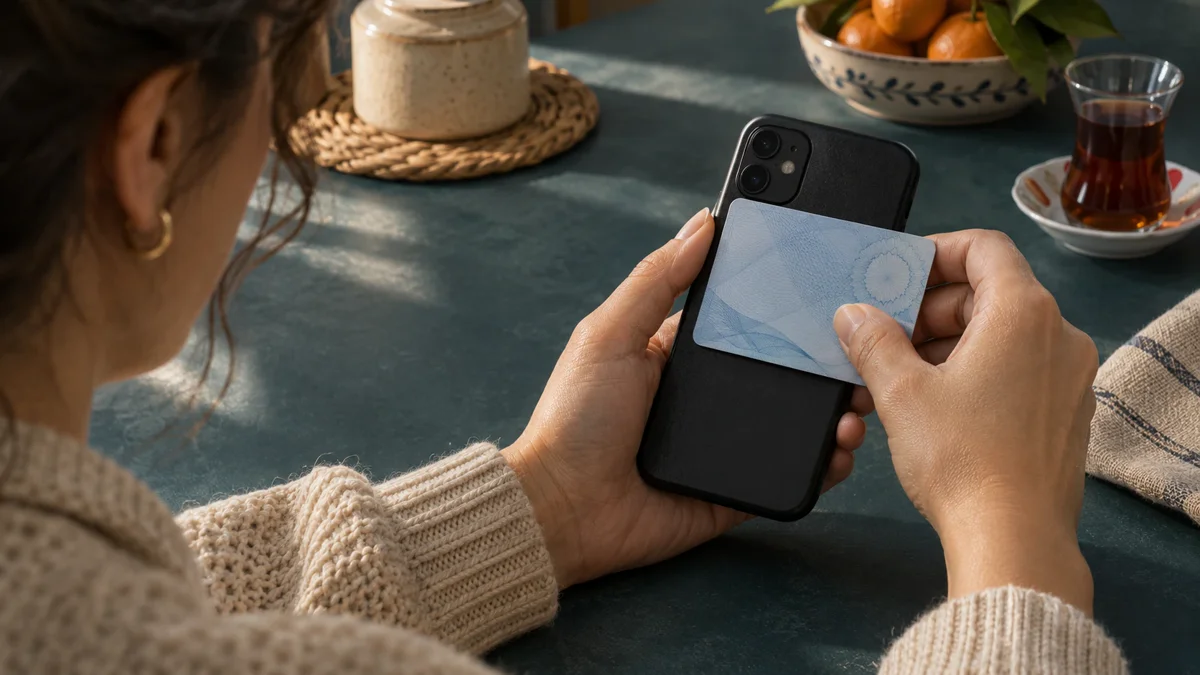
- Test what people do with a phone in one hand and an ID in the other
- Write recovery messages around the action the customer can actually take
- Return a verified customer to the payment they had in mind
- Give the experiment a business outcome and an operational owner
Imagine opening a wallet app to pay an electricity bill. You find your provider, enter the account number and see the amount due. The wallet asks you to verify your identity before you can pay. You hold your ID against the back of your phone. A few seconds later the app says, “Something went wrong.” Did you move the card too soon? Has the provider turned down your application? Will you have to look up the bill all over again?
The product team already knows something important about this customer. They came to pay a bill. A good identity verification journey explains the check, helps the customer recover when something goes wrong and returns them to the task they came to complete. For retail banking and wallet teams, that also gives acquisition a meaningful commercial outcome. How many people who start verification go on to make a payment? When their next bill is due, do they choose the wallet again?
Start with the regulated activity and the institution providing it
On 4 September 2026, Türkiye’s central bank, the CBRT, amended Article 41 of its payment services regulation to refer explicitly to biometric methods and identity documents that support electronic verification. The accompanying amendment to Article 22 of the information systems communiqué for payment and electronic money institutions specifies NFC as the primary way to check the identity document and its data. It also specifies methods and accompanying controls for cases where NFC verification cannot be completed. The example in this article concerns a wallet transaction that requires identification. A bank acquiring a customer through its own banking channel must assess the separate banking framework issued by the BRSA, known in Türkiye as the BDDK. CBRT regulation amendment · CBRT communiqué amendment · BDDK banking framework
This distinction matters when a bank distributes a service and a separate institution operates the wallet. Before drawing the screens, establish who provides the service, who makes the verification decision and who can see the status when the customer calls. Compliance can identify the checks that apply to this customer and transaction. Engineering can establish which results the verification provider actually returns. The digital channels team then has the information it needs to write an accurate message. If the provider has acknowledged receipt and the decision is pending, the interface has no basis for telling the customer their identity check failed.
Test what people do with a phone in one hand and an ID in the other
Near-field communication lets a phone read a chip at close range. The tricky part for the person holding the card is knowing what the device is doing. A vibration might mean that the chip has been detected. Someone who interprets it as a successful read will pull the card away. Someone else might break contact while turning the phone to get a better look at the progress indicator. Both could produce the same error in a dashboard. They point to different design decisions.
Recruit people who succeeded on their first attempt, people who had to retry, and people who sought help or left. Run the bill-payment task on real handsets with test credentials and test documents suitable for the environment. Let participants discover how to hold the card without coaching them first. Observe what they do at the first vibration, where they look for confirmation and what they think happened when the flow stops. Include someone who uses a screen reader. Can they tell that the read is still in progress without moving either hand? A dedicated research environment allows the team to investigate these questions without bringing production identity documents or biometric records into research tools.

Link each finding to a decision. If participants routinely lift the card at first contact, try distinct feedback for detection and completion. If failures cluster around one handset and verification software version, engineering has a compatibility question to investigate before design spends time redrawing the animation. If people finish the chip read but hesitate at the facial check, ask what they believe will happen to the image, who will see it and what information they wish they had before starting.
Write recovery messages around the action the customer can actually take
The communiqué provides for alternative methods with specified controls when NFC verification is unavailable. Product teams need to map those conditions to the routes their institution supports. Only then can they decide when it makes sense to offer another attempt, a different supported route or assistance. The following examples are candidate wording for a prototype. Official Gazette, amendment to Article 22
| Known state | Candidate message | What the team should verify |
|---|---|---|
| The read started, then contact was lost | “The scan stopped partway through. Hold your ID against your phone again until you hear or see the completion signal.” | The completion signal reflects a finished read and is distinguishable from the initial detection signal. |
| The device cannot perform this NFC step | “This phone can’t read the chip. See the other option available for your application.” | The alternative is available for this applicant. Where none is available, the interface offers an appropriate support route. |
| The provider received the information and the outcome is pending | “We’ve received your details. You can check progress in your application.” | Reopening the app retrieves the status of the same application. |
The last row is an engineering decision as much as a content decision. Losing connectivity tells the app very little about whether the provider received the request. On return, the channel should retrieve the application’s current status before inviting a retry. A support agent working from the same reference should be able to identify the completed step and the outstanding decision. That avoids putting a customer through another application while the first one is under review.
Return a verified customer to the payment they had in mind
Where the institution can securely retain the necessary details for an appropriate period, return the customer to the bill summary with the provider and account already selected. Fetch the amount again. If it has changed during verification, show the updated total and ask the customer to authorise the payment separately. A customer dropped onto the wallet home screen faces a second discovery task just as they are ready to transact.
There is also a natural place to test a relevant offer. A receipt could let someone save their billing account for next time. The customer has just seen exactly what that feature can do for them. Measure how many eligible people save the account, then how many use it for a payment in the next billing cycle. If the product team wants to assess revenue, it should also account for incentives and the additional cost of serving these transactions. A tap on “Save” tells only the first part of that story.
Give the experiment a business outcome and an operational owner
Start with eligible customers who entered verification from the bill-payment journey. One group uses the current experience. Another goes through the same verification controls and returns to the bill summary. Compare them over the same period and across comparable acquisition channels. Agree in advance on the observation window and which payment status counts as success.
| Product question | Suggested measure |
|---|---|
| Can people get through the chip read on their first attempt? | Unique applications with a completed first read divided by unique applications that started NFC. Review by handset family. |
| Do customers make their first payment? | Eligible users who successfully pay their first bill within seven days of starting verification divided by eligible unique users entering verification from the bill journey. |
| Do they come back? | Of first-time bill payers with a full 45-day observation window, the share who successfully pay another bill within that window. |
| What does the change cost? | Support contacts per thousand unique applications, manual review workload and the institution’s confirmed fraud indicators. |
Seven and 45 days are proposed observation windows. Use event times, step outcomes and software versions for the product analysis. Keep identity numbers, document images and biometrics outside product analytics. Check whether a provider release or a campaign changed the mix of applicants during the experiment. A jump in the headline conversion figure is worth understanding before it becomes the basis of an investment decision.
At VOYA, we would start a wallet review with three things the teams can usually bring to the same meeting: a recurring verification error, a few support conversations stripped of identifying details, and the transaction the customer was trying to complete. From there, we can work with compliance, engineering and digital channels on a prototype, acceptance criteria for the difficult cases and a measurement plan that reaches the first payment. The next bill gives the customer a chance to tell us, through their choice of channel, whether the experience is worth repeating. VOYA’s approach to UX audits


Explore All Blogs


















Ready to talk
about your project?
Do you have a clear vision regarding the ideas, goals, requirements, and desired outcomes for your project? Let's take the first step together by setting up a meeting to bring all of these to life.