VOYA Digital on the Cover of Fintechtime's September 2026 Issue

- VOYA Digital on the Cover of Fintechtime's September 2026 Issue
- UX is no longer only about designing good screens
- User experience is also a growth problem
- Artificial intelligence is redefining the financial product experience
- A new interface in fintech products: financial control
- In fintech, competition is increasingly shifting to experience
- VOYA Designs the New Experience of Fintech
VOYA Digital on the Cover of Fintechtime's September 2026 Issue
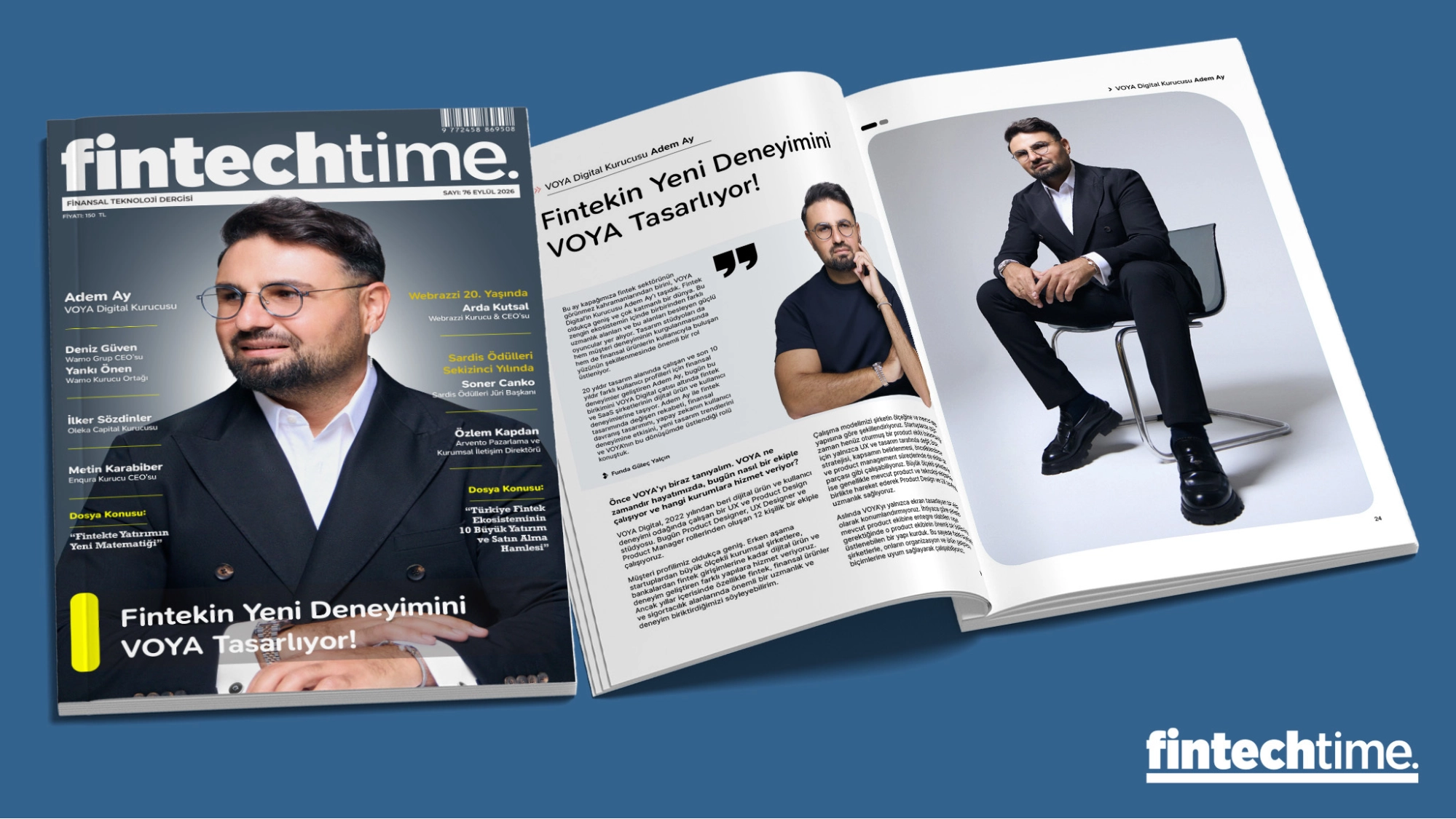
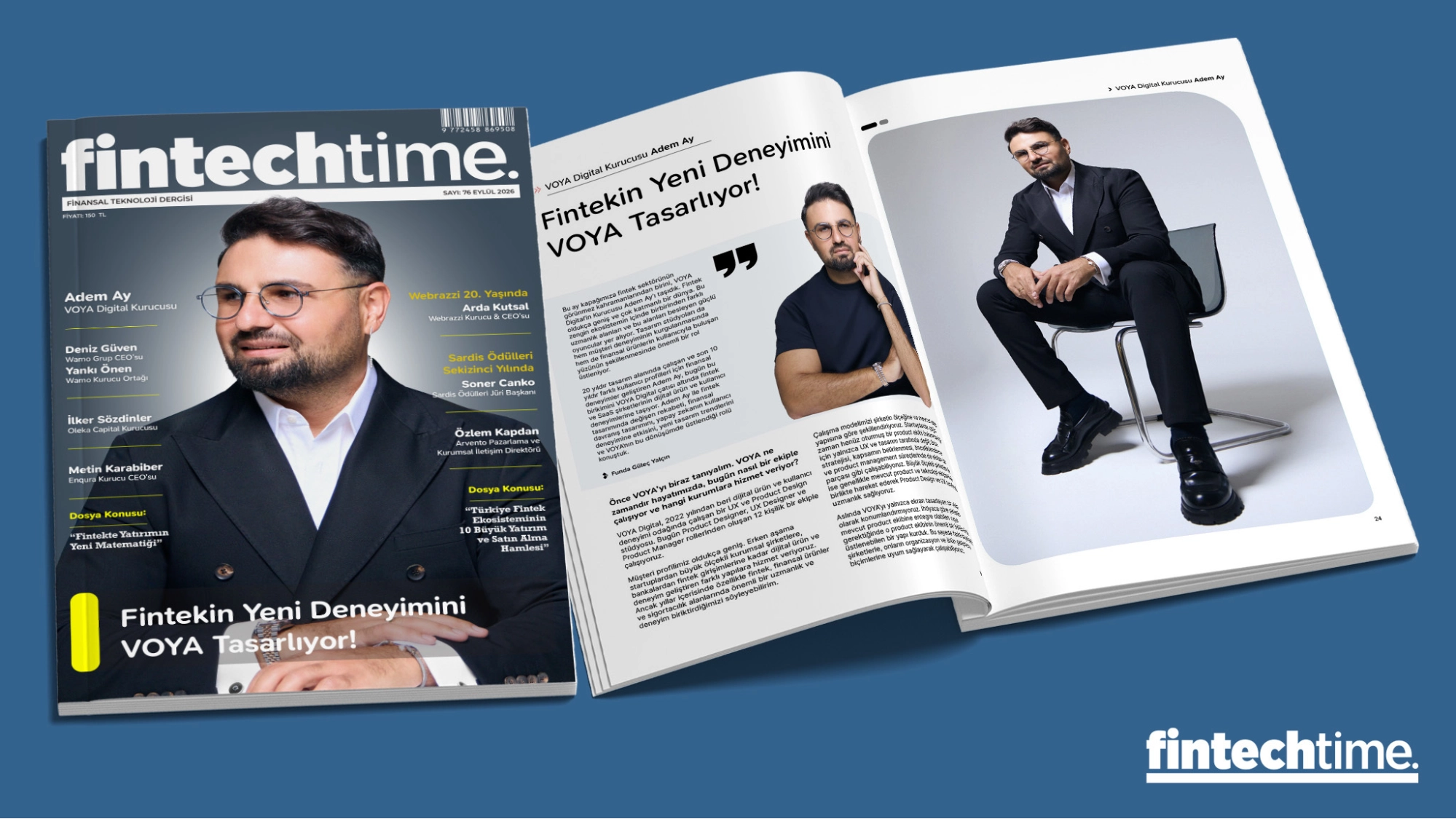
VOYA Digital founder Adem Ay is the cover guest of Fintechtime's September 2026 issue. In the interview published under the title “VOYA Designs the New Experience of Fintech!” we discussed fintech UX, financial behavior design, AI-powered financial products, and the impact of user experience on growth.
The September 2026 issue of Fintechtime, one of Turkey's leading fintech publications, holds a special place for VOYA.
Our founder Adem Ay appeared on the cover of Fintechtime's 76th issue under the title “VOYA Designs the New Experience of Fintech!”
For us, this cover is not just good news or valuable visibility. It is also one of the important signs that the expertise VOYA has built in recent years, especially around fintech, financial products, SaaS, and complex digital product experiences, is becoming visible to the industry.
In our cover interview with Fintechtime we talked about much more than how VOYA works as a UX and Product Design studio. Together we assessed where competition in financial products is heading, how user experience affects company growth, and how artificial intelligence will change the experience in finance applications.
UX is no longer only about designing good screens
There is an approach we have long championed at VOYA:
A good financial product is not simply a financial product that looks good.
User experience in fintech products requires thinking about money, trust, risk, regulation, and user psychology all at the same time.
A user pressing the wrong button in a shopping app does not carry the same weight as making a wrong decision while transferring money. Behind every step designed in financial products lies a much higher expectation of trust and control.
That is why one of the strongest statements in the Fintechtime interview summarizes our view of fintech design:
“Fintech no longer designs screens, it designs financial behavior.”
Today, fast money transfers, simple onboarding, or an easy-to-use mobile app are no longer points of differentiation for users. These are becoming the basic standards expected from any good financial product.
The real competition begins at the point of how well you can understand the user's financial life.
Helping the user make sense of their spending, see their upcoming payments, interpret their financial situation more accurately, or access the right information before an important decision are among the key parts of the next-generation fintech experience.
Here, the job of design is not to show the user more data.
It is to make the right information meaningful, at the right time, within the right context.
User experience is also a growth problem
When talking about fintech UX, we believe it is no longer enough to speak only about usability.
Because the UX decisions within a product can directly affect the product's commercial performance.
Onboarding that is longer than necessary can prevent you from getting a return on your user acquisition cost, positioning the KYC process at the wrong point can lead to user loss, a complex financial transaction flow can result in low conversion rates, and screens that are not understood can turn into more customer support requests.
Therefore, a UX problem is often also a business problem.
That is why, when evaluating products at VOYA, we do not operate only at the screen level. We treat questions like where the user comes from, when they understand the value of the product, at what point they complete their first successful transaction, where they drop off, and why they come back as a natural part of product design.
One of the examples we shared in the Fintechtime interview relates to KYC processes.
In two different fintech products we worked on, we moved identity verification out of the early stages of onboarding and placed it at the point where the user would actually perform a financial transaction. The goal was not to eliminate KYC; it was to place a mandatory step within the right context where the user could understand why they needed to complete it.
After this change, we saw a clear increase in the completion rates of registration and identity verification processes in both products.
Sometimes what changes product performance is not adding a new feature, but asking for the right step at the right time.
Artificial intelligence is redefining the financial product experience
One of the topics we focused on most in the interview was the impact of artificial intelligence on financial products.
AI-native financial products can significantly change the relationship users build with applications.
Today, the user carries out many financial transactions by moving between screens. In the coming period, artificial intelligence may prepare a significant portion of these transactions on the user's behalf, reduce the options, interpret financial data, and automate routine actions.
At first glance, these developments mean fewer screens.
But fewer screens do not mean fewer design problems.
On the contrary, the scope of design responsibility expands.
When can an AI system take action on behalf of the user? Which transactions absolutely require user approval? How much should the system explain the decision it makes? When an error occurs, how does the user regain control? Which information should be visible before a financial decision is made?
All of these questions are the subject of the next-generation user experience.
For this reason, the designer's role also moves beyond “Where should this button be?” toward “What should this system do in which situation, and at what point should the user take over control?”
In financial products, the success of artificial intelligence will be determined not only by the level of automation, but by how much the user can trust the system.
A new interface in fintech products: financial control
We do not think that users' expectation in financial products is only more automation.
The real expectation is to spend less effort without losing control.
The user may not want to repeat the same transactions every month, but they do want to see which transaction took place. They may want AI to interpret their financial data, but they may not want a critical decision to be made on their behalf without control.
Therefore, the future fintech experience will be shaped not only by faster or more automated products, but by products that can correctly balance automation and user control.
This perspective is also at the center of VOYA's approach to financial product design.
For us, good fintech UX is not about making the user perform as many transactions as possible, but about enabling the user to manage their financial life with as little cognitive load as possible.
In fintech, competition is increasingly shifting to experience
In the fintech ecosystem, technological infrastructures are becoming increasingly accessible.
Being able to make payments, transfer money, create a digital card, or access financial data may not be enough on its own for products to differentiate. As the number of products offering similar features grows, the competitive area of companies naturally changes.
At this point, fintech UX and product experience take on a much more strategic position.
We believe that products that understand the user better, can create personalized experiences, simplify complex financial processes, and do this without losing the sense of trust will stand out in the coming period.
As VOYA, we position ourselves right at the center of this transformation.
As a UX and Product Design studio that has worked with a focus on digital product and user experience since 2022, we address not only the interfaces of products but the entire experience, from user research to UX audit, from information architecture to onboarding and KYC flows, and from product design to design systems.
We use the experience we have built in fintech and financial products over the years in every new project, not just to produce better screens but to create better-working products.
That is why appearing on the September 2026 cover of Fintechtime is not just media visibility for us.
It is an important reflection of VOYA's approach in the field of financial product experience, fintech UX, and product strategy that we have long been investing in.
And honestly, we believe we are still at the very beginning of this field.
VOYA Designs the New Experience of Fintech
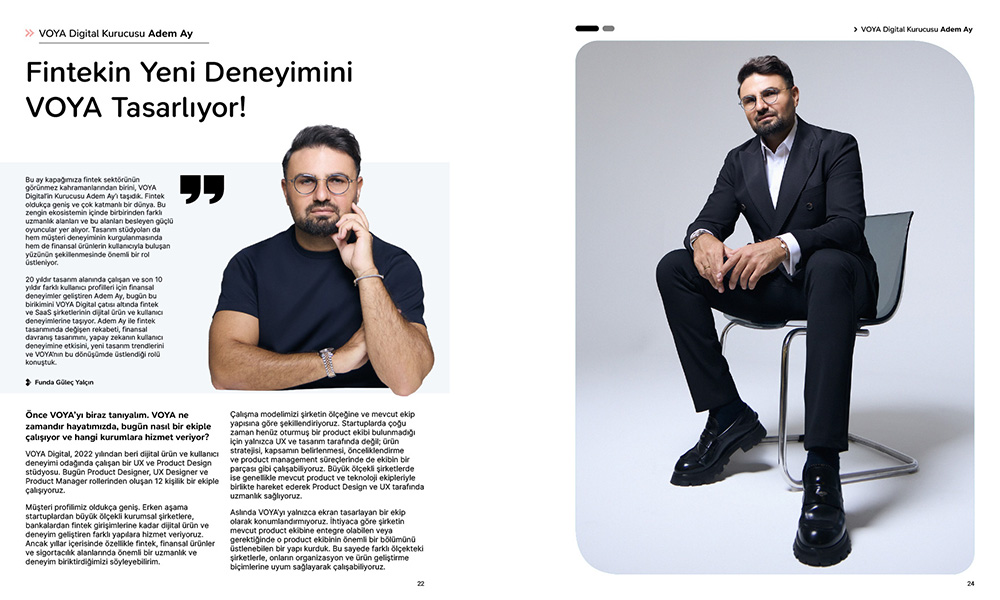
In our cover interview with Fintechtime, we talked about much more.
From lasting trends that will change the financial experience in the coming years to AI-powered financial assistants, from dynamic dashboard experiences to common UX mistakes fintech companies make, and from KYC and regulation processes to the relationship between product experience and growth, we assessed the future of the fintech world from different angles.
You can read the full cover interview titled “VOYA Designs the New Experience of Fintech!” on Fintechtime.


Explore All Blogs





















Ready to talk
about your project?
Do you have a clear vision regarding the ideas, goals, requirements, and desired outcomes for your project? Let's take the first step together by setting up a meeting to bring all of these to life.