Strategic UX: Gaining Competitive Advantage in Financial Products Through User Experience


- UX Is Not Just About Design
- 1. What Is UX Strategy and Why Does It Matter?
- 2. UX Challenges in Financial Products
- 3. UX = Trust = Loyalty
- 4. Building Product Strategy Through UX
- 5. Real-Life Example: The Money Transfer Flow
- 6. DesignOps and UX Maturity Model
- 7. Balancing UX and Compliance
- 8. Aligning UX with Business Goals
- 9. Data-Informed UX: Evolving the Strategy
- 10. Conclusion: UX Is Not a Cost—It’s a Growth Engine
- Thoughts from VOYA
UX Is Not Just About Design
In today’s digital finance ecosystem, user experience is no longer just about how interfaces look. It is a strategic function tied directly to product success, customer retention, and growth velocity. At VOYA, as a specialized UX studio for financial products, we see every day how strategic UX design impacts the performance of fintech solutions.
It’s not only about creating aesthetically pleasing designs. It’s about understanding user behavior, aligning with business goals, and crafting scalable, intuitive systems. In this article, we explore how to turn UX into a real competitive advantage in the financial sector, backed by examples and technical insights.
1. What Is UX Strategy and Why Does It Matter?
A UX strategy is more than interface guidelines—it’s a roadmap for how a product connects with its target audience. In financial products, this strategy includes:
- Simplifying complex financial data
- Building and maintaining user trust
- Designing intuitive, seamless processes
- Ensuring compliance without compromising usability
At VOYA, we integrate UX into the core of the product model, making it a shared responsibility between designers, product managers, and development teams.
2. UX Challenges in Financial Products
Financial services have inherent challenges:
- Complex content: Jargon, data-heavy screens, and hard-to-digest terminology
- Trust barriers: Money-related tasks create user anxiety
- Regulations: PSD2, GDPR, KYC, and other compliance constraints
- Diverse user levels: Financial literacy varies widely among users
A capable UX studio can turn these challenges into opportunities by creating tailored, user-centric solutions.
3. UX = Trust = Loyalty
The longevity of a user’s relationship with a financial product depends on trust. Trust isn’t built with slogans—it’s established through details:
- Transparent, well-structured information
- Clear system feedback (“Your transaction was successful”)
- Helpful error states with guidance
- Double verification on sensitive actions
In our projects at VOYA, we track how trust influences engagement and continuously refine based on real user behavior.
4. Building Product Strategy Through UX
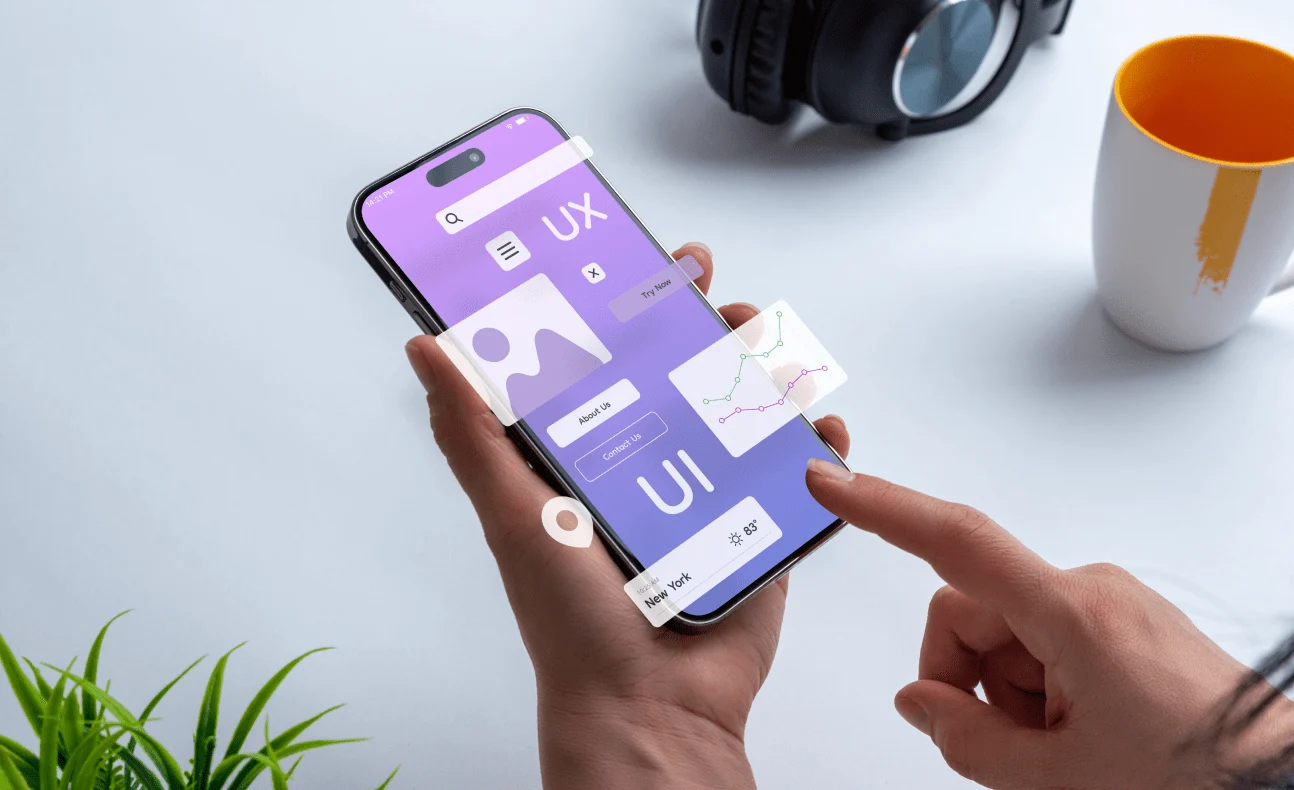
UX is no longer the last step—it’s a strategic part of product planning. Even at the MVP stage, critical questions must be asked:
- What problem is this experience solving?
- How often and in what context will the user interact with it?
- Are there points of friction or confusion in the flow?
Key Strategic Steps
- Persona-focused planning – Segment users based on financial behaviors.
- Journey mapping – Analyze the entire customer lifecycle, not just the app screens.
- Defining UX KPIs – Track completion rates, NPS, and support request volumes.
- Micro-interaction strategy – Enhance perceived value through small, thoughtful interactions.
5. Real-Life Example: The Money Transfer Flow
Even a simple money transfer scenario has multiple UX layers:
- Is the transfer form easy to understand?
- Where do users hesitate or abandon the process?
- Is the confirmation process transparent?
- How is post-transaction feedback delivered?
Small optimizations here can directly boost customer satisfaction and repeat usage.
6. DesignOps and UX Maturity Model
Financial products are never “done” after one design round. Strategic UX means building sustainable systems inside the organization:
- DesignOps ensures scalable design processes.
- Design Systems bring visual and interaction consistency.
- UX Maturity Models measure team capability and guide improvement.
At VOYA, we implement these frameworks to transform both products and the organizations behind them.
7. Balancing UX and Compliance
Regulations like PSD2, GDPR, and AML are often seen as UX blockers, but they can drive creative solutions:
- GDPR consent forms can be made simple and engaging.
- 2FA flows can be both secure and fast.
- Required disclosures can be visualized with infographics.
Strategic UX is about achieving compliance without compromising on user experience.
8. Aligning UX with Business Goals
UX decisions must align with measurable business outcomes. For financial products, that means:
- Increasing conversion rates to grow revenue per user
- Reducing operational costs by lowering support demand
- Boosting lifetime value through customer retention
At VOYA, every UX decision is made within a framework tied to business KPIs.
9. Data-Informed UX: Evolving the Strategy

A UX strategy isn’t fixed it evolves with user behavior. Data-backed studios have the edge here.
Key data sources include:
- Funnel analytics
- Heatmaps
- Usability testing insights
- A/B test results
- Customer support logs
We turn these into actionable insights for continuous improvement.
10. Conclusion: UX Is Not a Cost—It’s a Growth Engine
Many fintechs still treat UX as a final layer or a luxury. In reality, a strong UX studio builds the growth model itself around experience.
UX = Usability + Trust + Intuition + Emotional Connection
This equation drives loyalty, repeat transactions, and brand equity in financial products.
Thoughts from VOYA
At VOYA, we see UX not as a design deliverable but as the core of the business. Our work in fintech and digital banking shows us every day how strategic UX design generates measurable business growth.
If you want your financial product not just to be “used” but to be part of your users’ daily lives, place UX at the heart of your strategy.


Explore All Blogs

















Ready to talk
about your project?
Do you have a clear vision regarding the ideas, goals, requirements, and desired outcomes for your project? Let's take the first step together by setting up a meeting to bring all of these to life.