Designing Because “They Said So”: Who Makes the Decisions in Product Development?


- The Visible and Invisible Sides of the Design Process
- Design Processes Do Not Progress Linearly in Real Life
- Three Major Realities That Shape Design Decisions
- Budget: The Invisible Constraint of Design
- Time: The Greatest Pressure on Design
- The HIPPO Effect: Does Data Speak, or Does Title?
- The Most Critical Component of Design: Storytelling
- The True Owner of Design: The User
From the outside, digital product design often appears to be a linear, structured, and clearly defined process. A need emerges, a design is created, development follows, and the product is delivered to users. In reality, however, the process is rarely as clean or predictable as it seems in theory.
Design is not merely a production phase where aesthetic decisions are made. It is a strategic discipline that requires continuously balancing constraints, assumptions, stakeholder expectations, and real user behavior.
In this article, we will explore three fundamental realities frequently encountered in digital product design. We will also examine how user-centered decision-making can be sustained within these realities.
The Visible and Invisible Sides
of the Design Process
In theory, a design process is fairly straightforward. A request is received,
the designer analyzes it, develops a solution, revisions are made, and the
outcome is handed over to development.
In practice, however, the process is far more complex.
A designer is not simply someone who visualizes a request. A designer
questions whether the request is valid, whether it addresses the real problem,
and most importantly, whether it creates meaningful value for the user.
Every design process involves four key stakeholders:
- The individual or organization submitting the request
- The team defining the need
- The team responsible for the design
- And most importantly, the end user
These four perspectives rarely align perfectly. The design process is fundamentally about creating that alignment.

Design Processes Do Not Progress Linearly in Real Life
Digital product design rarely begins with a perfectly defined and
comprehensive brief. At times there is detailed documentation, but in many
cases there is only an idea or a high-level objective. Occasionally, even the
problem itself is not clearly articulated before solutions start being
discussed.
For this reason, the first step in the design process is not
creating interfaces. It is developing a clear understanding of the problem.
Strong products are built on well-defined problems.
The process does not move forward in a straight line. Feedback
loops, technical constraints, and emerging insights continuously reshape
decisions. Design is not a one-time deliverable. It is an iterative discovery
process that evolves through learning and refinement.
Three Major Realities That
Shape Design Decisions
In digital product design, decisions are not always driven solely by user
experience considerations. In many cases, three fundamental factors directly
shape the process:
- Budget
- Time
- HIPPO (Organizational Hierarchy)
These factors are inevitable components of the design process.
Budget: The Invisible Constraint of Design
A design solution may offer the optimal user experience. However, its
development cost can directly affect its feasibility. At this stage, the role
of the designer extends beyond proposing solutions. It involves articulating
the value behind those solutions.
It is just as important to discuss the cost of implementing a design decision
as it is to highlight the opportunity cost of not implementing it.
For example, the business impact of design decisions can be made
tangible through metrics such as:
- User churn rates
- Drop-off during task completion
- Declining conversion rates
When framed in this way,
design is positioned not as an expense, but as a strategic investment.
Time: The Greatest Pressure on Design
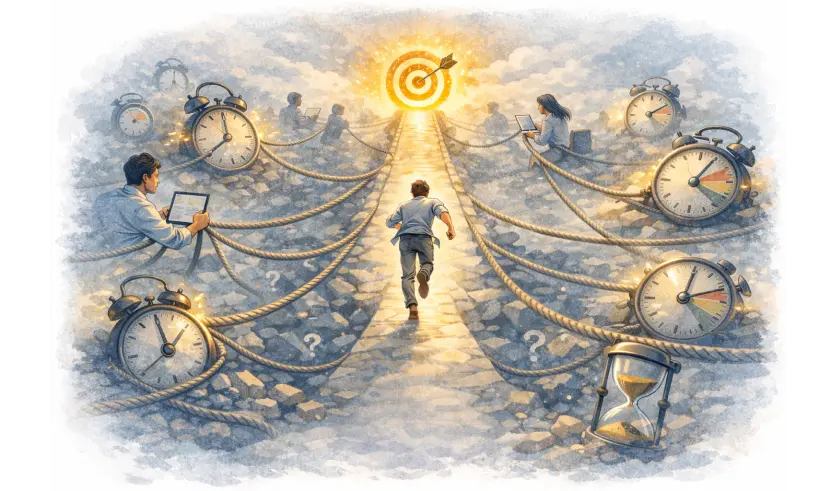
Time pressure is one of the most common constraints in digital product design.
Approaching deadlines often push designers to implement requests as quickly as
possible. However, the objective of design is not merely to deliver on time,
but to solve the right problem in the right way.
At this stage, the most critical skill is not stretching
timelines, but defining scope accurately. Instead of attempting to solve
everything at once, teams identify a Minimum Viable Product (MVP) that
delivers the highest user value. This approach sharpens focus and allows the
product to evolve iteratively through real user feedback.
At the same time, not every problem needs to be solved from
scratch. Benchmark analyses, products that have addressed similar challenges,
and established industry standards provide strong reference points. In recent
years, AI-powered tools have also become valuable accelerators, particularly
in generating initial drafts and rapidly evaluating alternative solutions.
As Parkinson’s Law suggests, the goal is not to expand the time
allocated, but to focus on what truly matters. Speed does not imply
superficiality. Advancing with a well-defined scope enables teams to make
decisions that are both faster and more effective.

The HIPPO Effect: Does Data Speak, or Does Title?
In digital product design, decisions are not always driven by data, user
needs, or product strategy. At times, the direction of a decision is shaped by
the personal preference of the most senior person in the room. In the
literature, this phenomenon is referred to as HIPPO, or the Highest Paid
Person’s Opinion.
The HIPPO effect describes situations where an idea gains priority
not because of its validity, but because of the position of the person who
voices it. This may involve something as minor as a color preference, or it
may extend to more significant decisions that directly influence the product’s
flow and overall experience.
In such cases, the role of the designer is not to confront the
decision outright, but to move the discussion onto the right foundation. The
first step is to demonstrate that the perspective has been heard and
respected. Design is not only about identifying the right solution; it is also
about building trust and collaboration.
The next step is to shift the conversation from personal
preference to a user-centered framework. User behavior insights, benchmark
examples, usability testing results, and measurable data help ground decisions
in objective criteria. This approach transforms a subjective opinion into a
solution that genuinely serves the user.
The goal is not to reject an idea, but to create common ground
where all stakeholders can align on what is best for both the product and its
users.
Strong products are shaped not by personal preferences, but by user
realities.

The Most Critical Component of Design: Storytelling
In the design process, producing solutions is only part of the responsibility.
Equally important is the ability to communicate those solutions effectively.
Even the most well-crafted design cannot deliver its full value if the
thinking behind it is not clearly articulated.
For designers, every presentation is, in essence, a process of
persuasion. It is not enough to explain what has been designed. It is
essential to clarify why it has been designed that way. Unless we can
demonstrate the problem it solves, the value it creates for users, and why it
is stronger than alternative approaches, the design remains merely an opinion.
Strong designs gain acceptance not only because they offer the
right solution, but because the story behind that solution is conveyed with
clarity and conviction.
The True Owner of Design: The User
Throughout the design process, multiple stakeholders are involved. Product
teams, executives, business objectives, and technical constraints all
influence design decisions. Yet at the end of this process, the true owner of
the design is always the user.
As Don Norman emphasizes, what matters is not how we want users to
behave, but how they actually behave. Alan Cooper’s perspective reinforces
this principle clearly: the user is the ultimate decision-maker of the
product.
For this reason, the purpose of design is not simply to fulfill
incoming requests. The real objective is to understand user behavior and
create the right experience accordingly.
Good design is not created “because it was requested.” It is created because
it is demonstrably the right solution for the user. Strong digital products
are built not on assumptions, but on user realities.


Explore All Blogs











Ready to talk
about your project?
Do you have a clear vision regarding the ideas, goals, requirements, and desired outcomes for your project? Let's take the first step together by setting up a meeting to bring all of these to life.